Cart
0

If you've ever come home from a beach holiday with a perfect tan on every inch of skin — except for the pale patches left behind by your swimwear — you already understand the problem that tan through swimwear was designed to solve.
But how does it actually work? Is it really possible for a fabric to let sunlight through while still keeping you covered? And is it safe?
At Volagor, we've been pioneering tan through swimwear since the 2010s, and our Japanese-engineered fabric remains one of the most advanced technologies in swimwear today. Here's everything you need to know.
What Is Tan Through Swimwear?
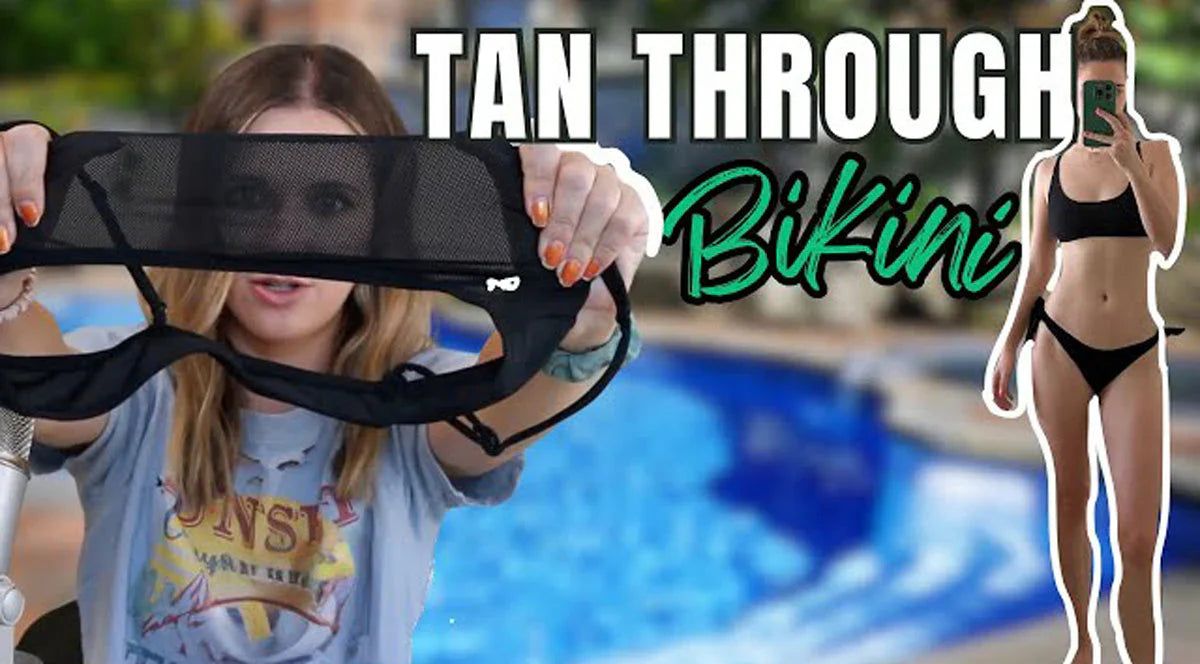
Tan through swimwear is exactly what it sounds like: swimwear made from a specially engineered fabric that allows UV rays from the sun to pass through to your skin, so you can develop a more even, natural-looking tan — even in areas covered by your suit.
Unlike standard swimwear, which can block up to 99% of UV light and create those familiar stark tan lines, tan through swimwear lets a controlled amount of sunlight reach your skin beneath the fabric.
The result? A smoother, more even glow all over — without the need to constantly readjust your costume or risk overexposing your skin.
Material Science — The 85/15 Golden Ratio
Premium tan-through swimwear must balance three conflicting factors: UV permeability, elasticity, and durability. The industry gold standard is a blend of 85% Polyester and 15% Spandex.
2.1 The Structural Integrity of Polyester
Polyester provides the "skeleton" of the fabric. Because the material is micro-perforated, the fibers must be exceptionally strong to prevent becoming brittle after exposure to salt water and intense UV. High-grade polyester ensures the suit retains its shape and resists tearing even under tension.
2.2 Dynamic Contour with Spandex
The 15% Spandex content ensures the swimsuit hugs the body like a second skin. This is vital for an even tan; if the fabric wrinkles or sags, the angle of sunlight becomes inconsistent, resulting in a mottled or "patchy" skin tone.
The Science Behind It: How Does the Fabric Work?
The secret lies in the fabric's structure. Volagor's Japanese-engineered fabric — the heart of our tan through range — is woven with millions of tiny square and diamond-shaped micro-perforations. These holes are so small they're invisible to the naked eye, but together they act like a precisely calibrated filter for sunlight.
Here's what happens when you wear it in the sun:
1. UV rays enter through the micro-perforations
Rather than being absorbed or blocked by solid fibres, UVA and UVB rays pass directly through the tiny openings in the weave and reach your skin underneath.
2. The fabric diffuses the light evenly
The surrounding fibres scatter and spread the incoming light as it passes through. This diffusion effect is important — it means your skin receives an even distribution of sunlight across the covered area, rather than a patchwork of concentrated spots. No dot-matrix tan pattern, just a smooth, consistent glow.
3. The fabric still offers UV protection
This is the clever balancing act. Volagor's Japanese-engineered fabric is engineered to allow between 70–80% of UV tanning rays through — enough to tan your skin naturally — while still filtering out a proportion of the more harmful rays. This gives the fabric a UV Protection Factor (UPF) roughly equivalent to a low-level sunscreen.
4. Special prints prevent transparency
Holes in fabric could mean a see-through swimsuit — which is where Volagor's design expertise comes in. Our bold, carefully engineered prints are specifically designed to visually camouflage the micro-perforations, so the fabric appears completely opaque to the eye. What looks like a standard vibrant print is actually doing double duty: it keeps the suit modest while letting the sun do its work.
Why Does Tan Through Fabric Dry So Much Faster?
An added bonus of the micro-perforation structure: air can pass through the fabric just as UV rays do. This makes Volagor's Japanese-engineered fabric swimwear far more breathable than standard swimwear, and dramatically faster-drying — up to three times quicker than conventional fabrics. For travellers who want to pack light and avoid damp suits in a bag, this alone makes it worth it.
Will It Actually Give Me a Tan? Setting Realistic Expectations
Yes — but with a few important caveats.
Tan through swimwear is not magic. How quickly and evenly you tan depends on the same factors that apply to tanning in general: your skin type and melanin levels, the intensity of the sun, the time of day, and the duration of your exposure.
The tan through effect tends to build gradually over consistent use. Volagor recommends wearing your swimwear as regularly as possible over a continuous period — the longer and more frequently you wear it in the sun, the more your skin will develop colour through the fabric.
You should also keep in mind:
-
Always wear sunscreen. Tan through swimwear is not a substitute for sun protection. Because a significant percentage of UV rays do reach your skin, you should apply a broad-spectrum UVA and UVB sunscreen to all exposed areas — including beneath the fabric on sensitive skin.
-
Results vary by skin type. People who tan easily and quickly will see faster results through the fabric than those with fairer skin that burns before it browns.
- The fabric doesn't eliminate all tan lines — it minimises them. You'll still have some variation at the fabric's edges, but the stark contrast of conventional swimwear lines will be significantly reduced.
Is Tan Through Swimwear Safe?
This is a fair question. The short answer is yes — when used responsibly, in the same way you would approach any time spent in the sun.
The fabric's UPF rating means it does provide some level of UV filtration. Think of it as wearing a very light, sheer sunscreen layer over the covered parts of your body. You're not receiving unfiltered direct sunlight — the fabric is still doing protective work. But because UV rays do penetrate through, you should:
- Apply SPF sunscreen under and around the suit
- Avoid prolonged exposure during peak sun hours (typically 11am–3pm)
- Follow standard safe sun guidance for your skin type
Tan through swimwear is particularly popular among people who want to support healthy vitamin D production during sun exposure — something traditional swimwear can actually work against by blocking sunlight from large areas of the body.
What Makes Volagor's Japanese-engineered fabric Different?
Volagor has been refining tan through fabric technology for over four decades. Our Japanese-engineered fabric — used across our current swimwear range — represents years of development in softness, colour vibrancy, durability, and UV performance.
Key features of Volagor's Japanese-engineered fabric:
-
Fabric composition: 87% Nylon, 13% Spandex — for stretch, recovery, and long-lasting fit
-
UV transmission: Allows 70–80% of tanning rays through
-
Drying time: Up to 3x faster than standard swimwear fabrics
-
Crease resistance: Perfect for packing in a suitcase without ironing
-
Opacity: Specially designed prints ensure the suit is never see-through
- Made in USA: Every piece is crafted in our Staffordshire studio
Ready to Try It?
If you've spent years coming home from holiday with unwanted tan lines, tan through swimwear is one of the most effective solutions available — and Volagor remains the original British pioneer of the technology.
Browse our full range of men's and women's tan through swimwear, including swim briefs, bikinis, swimsuits, and beach wraps — all made from our signature Japanese-engineered fabric, and all designed and handcrafted in England.
Always use appropriate sun protection when wearing tan through swimwear. Volagor recommends a broad-spectrum sunscreen with both UVA and UVB protection.